
 Service


SDW(Shapefile World File)
SDW files (Shapefile World File) are one of the subsidiary files of Shapefile files, which are used to store the projection and coordinate system information of Shapefile. Shapefile is a commonly used Geographic Information System (GIS) data format for storing geospatial data and attribute data. SDW files are usually used together with Shapefile’s SHP files and other related files such as DBF and PRJ files.
2025-09-16 14:47:33
JP2(JPEG 2000)
JP2 is the file extension of JPEG 2000, which indicates an image file compressed using the JPEG 2000 compression algorithm. JPEG 2000 is an improvement and extension of the traditional JPEG image compression algorithm, which uses a compression technology based on wavelet transform. This format plays an important role in digital image processing, providing an efficient and reliable way to store and transmit image data.
2025-09-16 14:47:32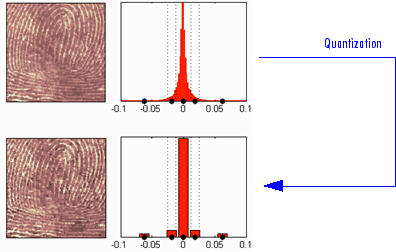
ECW(Enhanced Compression Wavelet)
**ECW **(Enhanced Compression Wavelet) is an image compression format designed to efficiently compress and store large-scale raster image data, especially for remote sensing images and map data. The ECW format compresses image data using wavelet transform technology to reduce the volume of data while maintaining image quality as much as possible. The ECW file format was developed by Earth Resource Mapping (now Hexagon Geospatial) and is widely used in geographic information systems (GIS) and remote sensing fields.
2025-09-16 14:47:32
PIX(PCI Geomatics Database File)
PIX (PCI Geomatics Database File) is a file format used to store and process image and raster data. The PIX format is often used to process remote sensing data, such as satellite images, digital elevation models, and meteorological data. It is a binary format that can store multi-channel, multi-resolution data, supports image compression, and can store metadata and geospatial information.
2025-09-16 14:47:31
BSQ(Band Sequential)
BSQ (Band Sequential) is a file format for storing multi-band raster data, which is widely used in remote sensing, geographic information system (GIS), image processing and other fields. BSQ is a format that stores data in band order. The data of each band is arranged in a linear manner, and the storage structure is simple and efficient.
2025-09-16 14:47:31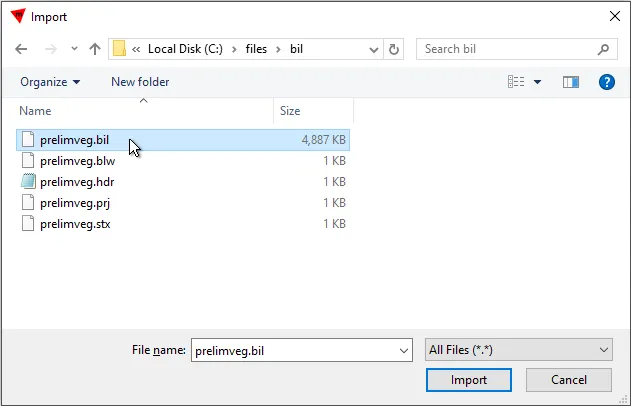
BIL (Band Interleaved by Line)
BIL (Band Interleaved by Line) is a geospatial data format commonly used to store remote sensing images and geographic information system (GIS) data. BIL is a multi-band image storage method with interleaved lines. Its core feature is to store multi-band image data alternately in the file in line order. That is, each line of data contains the pixel values of all bands, and the storage order is: the first line of band 1, the first line of band 2, …, the first line of band n, and then the second line of all bands, and so on.
2025-09-16 14:47:30
BIP(Band Interleaved by Pixel)
BIP (Band Interleaved by Pixel) is a raster data storage format. It stores all bands for each pixel together in order, which means that all band values for a pixel are stored adjacently, instead of storing all pixel values of the first band together, then the second band, and so on. In this format, each pixel value in the raster data is stored in consecutive bytes, rather than in band or sample order as in the BIL or BSQ format. Therefore, in the BIP format, the distance between pixels is minimized, so it is more efficient when reading and writing data.
2025-09-16 14:47:30
RDC(IDRISI Raster Documentation File)
RDC (IDRISI Raster Documentation File) is a format that stores raster data as a three-dimensional data cube. Each data unit consists of spatial location, time, and attribute values. In RDC, the spatial location can be longitude and latitude, UTM coordinates, or other geographic spatial reference systems. The time can be one or more time series, which can represent data at multiple time points or time series data. The attribute value is the characteristic data of the raster cell, such as temperature, altitude, or other geographic information.
2025-09-16 14:47:29
OVR(Overview File)
OVR (Overview File) is a file format used to optimize the rapid access and visualization of large-scale imagery or geographic data. It is commonly used in geographic information systems (GIS) as a pyramid file or thumbnail storage method for image data, helping users quickly load, view, and process image data at different resolutions. OVR files reduce the frequent access to original high-resolution data by pre-generating image data of different resolutions, thus significantly improving data rendering efficiency.
2025-09-16 14:47:29
RST(reStructuredText)
RST file, or reStructuredText file, is a lightweight markup language that uses simple markup syntax to write documents. It was first created and developed by David Goodger in 2002 and is mainly used for document writing and formatting. RST files usually have the extension “.rst” and use some specific symbols and structures to represent the various parts of the document, such as titles, lists, links, references, etc.
2025-09-16 14:47:29