
 Service


GXT
GXT / MapInfo Custom Coordinate System File is a text-based format used in MapInfo Professional to define custom map projections, coordinate systems, and datum transformations. Managed as part of MapInfo's spatial data management ecosystem, it enables users to extend beyond predefined coordinate systems by creating custom definitions tailored to specific local surveying needs, specialized datasets, or regional mapping requirements. It serves as an essential configuration tool for ensuring spatial data aligns correctly across different maps and layers.
2026-02-28 15:28:51
COLLADA / DAE (Digital Asset Exchange)
COLLADA / DAE is an open standard 3D data format designed for the exchange of 3D models and digital assets. Managed by the Khronos Group, it is XML-based and can describe 3D geometry, materials, textures, animations, scene structures, and more. It is widely used as a "neutral exchange format" enabling data interoperability between different software applications in game engines, 3D CG production tools, BIM, and the 3D GIS field.
2026-02-27 15:12:56_1772176271342.png)
OBJ (Wavefront 3D Model Format)
OBJ (Wavefront 3D Model Format, can include geographic coordinates) is a plain text 3D format developed by Wavefront Technologies. It stores geometric information (vertices, normals, UV coordinates) and polygonal face data, and supports referencing textures and lighting properties through external .mtl material files. Its openness and cross-platform compatibility make it a universal intermediate format in fields such as 3D modeling, game development, and 3D printing. However, it requires additional files to define georeferencing and does not support animation or complex scene data.
2026-02-27 15:07:23
SuperMap iServer REST API
SuperMap iServer REST API is a comprehensive, resource-oriented application programming interface that exposes the full spectrum of GIS functionalities through standard HTTP protocols. Built upon the Representational State Transfer (REST) architectural style, this API encapsulates core GIS capabilities—including map services, data management, spatial analysis, 3D visualization, and distributed processing—as addressable resources uniquely identified by URIs. By adhering strictly to REST principles, SuperMap iServer transforms complex GIS operations into simple, lightweight HTTP interactions that support multiple representation formats (JSON, XML, HTML, binary images) and standard HTTP methods (GET, POST, PUT, DELETE). This design enables developers, system integrators, and GIS professionals to build web and mobile applications that seamlessly integrate with enterprise geospatial infrastructure, whether for dynamic map visualization, real-time spatial querying, or large-scale distributed spatial analytics .
2026-02-25 14:39:27
TileJSON
TileJSON is an open standard for describing map tile layers and their capabilities in a machine-readable JSON format. Originally developed by Mapbox as a specification for their mapping platforms, it has since evolved into a widely adopted community standard for declaring metadata about tile sets—whether they are raster tiles, vector tiles, or terrain tiles. A TileJSON file provides a structured, human-readable, and developer-friendly way to communicate essential information such as the tile server's endpoint URL, the tile format (PNG, MVT, GeoTIFF, etc.), the spatial extent (bounds), the coordinate reference system (commonly Web Mercator - EPSG:3857), the minimum and maximum zoom levels, attribution requirements, and other descriptive metadata. This standard enables map clients, styling tools, and data catalogues to automatically discover and consume tile services without requiring manual configuration or prior knowledge of the tile source's internal structure.
2026-02-25 14:29:21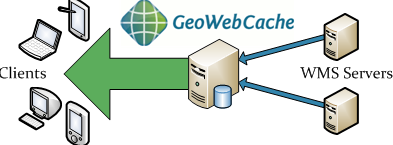
GeoWebCache
GeoWebCache is a high-performance, tile-caching server designed specifically for accelerating the delivery of geospatial map data over the web. It functions as a critical middleware component that sits between a map server (such as GeoServer, MapServer, or ArcGIS Server) and a map client (like OpenLayers, Leaflet, or MapLibre). By generating, storing, and serving pre-rendered map image tiles in standard web formats (PNG, JPEG, vector tiles), it dramatically reduces server load and improves response times for end users. Unlike rendering maps dynamically for each request, GeoWebCache serves pre-computed tiles, making it an essential tool for building scalable, fast, and responsive web mapping applications that serve large volumes of concurrent users.
2026-02-11 14:18:10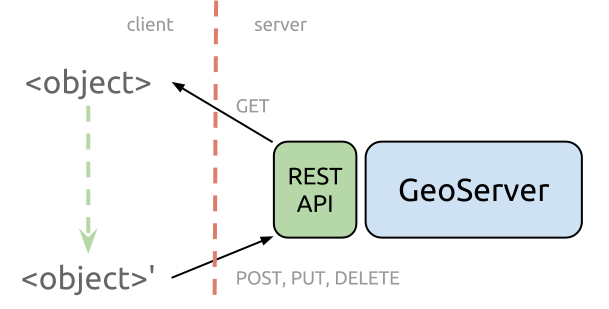
GeoServer REST API
GeoServer REST API is a comprehensive programmatic interface for configuring and managing the GeoServer open-source geospatial data server. As an integral component of the GeoServer software suite, the API provides a standardized HTTP-based mechanism to automate and control virtually all administrative and data publishing tasks within a GeoServer instance. It enables developers, system administrators, and GIS professionals to interact with GeoServer programmatically—creating workspaces, adding data stores, publishing layers, configuring styles (SLD), managing security, and adjusting service settings (WMS, WFS, WCS) without using the web administration interface. This API is essential for integrating GeoServer into automated DevOps pipelines, multi-instance deployments, and custom geospatial application backends.
2026-02-11 14:01:51
Space Oblique Mercator (SOM) Projection
Space Oblique Mercator (SOM) Projection is a sophisticated, specialized map projection designed specifically for mapping the continuous surface coverage of Earth-observing satellites in near-polar, sun-synchronous orbits. Conceived in the 1970s by Alden P. Colvocoresses and later refined by John L. Junkins, John P. Snyder, and others, it solves a unique problem: accurately representing the curved, swath-based ground track of a satellite moving in space while the Earth rotates beneath it. Unlike traditional projections that treat the Earth as static relative to the Sun, the SOM mathematically models the dynamic relationship between the satellite's orbital path and the Earth's rotation, creating a nearly conformal map where the satellite's ground track is represented as a straight line with minimal scale distortion along the swath.
2026-02-11 13:52:04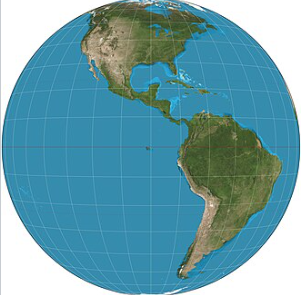
General Perspective Projection
General Perspective Projection is a family of azimuthal map projections that simulate the view of the Earth from an arbitrary point in space, creating a perspective effect akin to a photograph taken from a distant observer. Unlike orthographic or stereographic projections which assume specific viewing distances or geometric relationships, this projection allows flexible positioning of the projection point—either above the Earth's surface (for satellite or aerial views) or at an infinite distance. It is particularly valuable for visualizing planetary bodies from space missions, generating realistic global and regional views, and supporting applications in astronomy, remote sensing, and scientific visualization where naturalistic perspective is prioritized over geometric preservation.
2026-02-06 15:09:58
Tissot Indicatrix
Tissot Indicatrix is a classical method in cartography used to quantify and visualize distortions inherent in map projections. Developed by French mathematician Nicolas Auguste Tissot in the 19th century, it provides a precise geometric tool for analyzing how angles, areas, and shapes are deformed when transferring locations from the Earth's surface to a map. Rather than representing a projection itself, the indicatrix consists of plotting infinitesimal circles onto a projection grid to demonstrate how they become ellipses or other shapes under different projection transformations. This method enables an intuitive and scientific comparison of projection properties and remains foundational for evaluating projection suitability across mapping, geomatics, and geographic education.
2026-02-06 14:53:50