
 Service

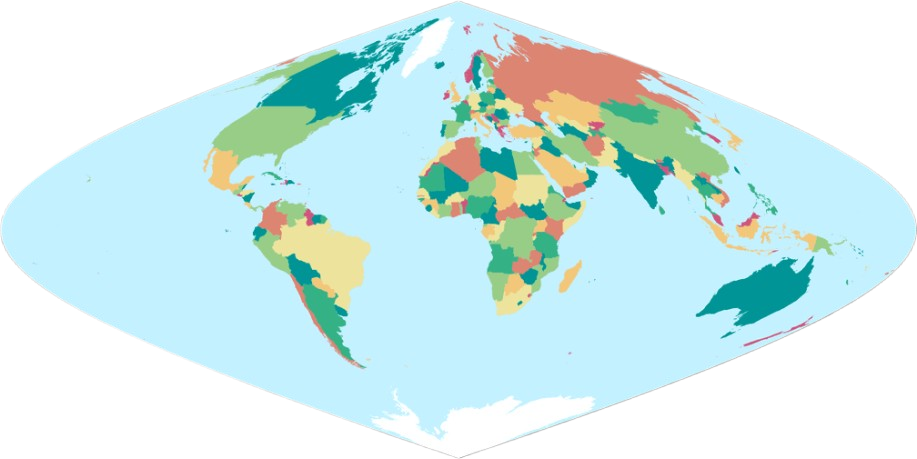
Putnins P6 Projection
Putnins P6 Projection is a pseudoconic equal-area projection proposed by Soviet geographer A. Putnins in the mid-20th century. Designed specifically for world maps, it aims to accurately preserve the area relationships between land and ocean. In this projection, the Earth’s graticule is projected onto a conical surface and then unfolded into a plane, resulting in meridians represented by straight lines radiating from a common vertex and parallels as concentric circular arcs centered at that vertex. Distortion is minimized near the standard parallels and increases with distance from them, yet area distortion remains zero throughout.
2026-03-26 18:36:15
OpenMapTiles Server
OpenMapTiles Server is open-source map server software for delivering vector map tiles. Developed by the OpenMapTiles project, it enables high-speed distribution of vector tiles (in Mapbox Vector Tile format) generated from geospatial data such as OpenStreetMap (OSM). It can be easily deployed in local server or cloud environments, and by combining it with web mapping libraries such as MapLibre GL, Mapbox GL JS, and Leaflet, high-performance interactive mapping applications can be built. OpenMapTiles Server is equipped with features such as tile caching, style management, and API delivery, and is widely used as a foundation for operating custom map services.
2026-03-24 19:12:00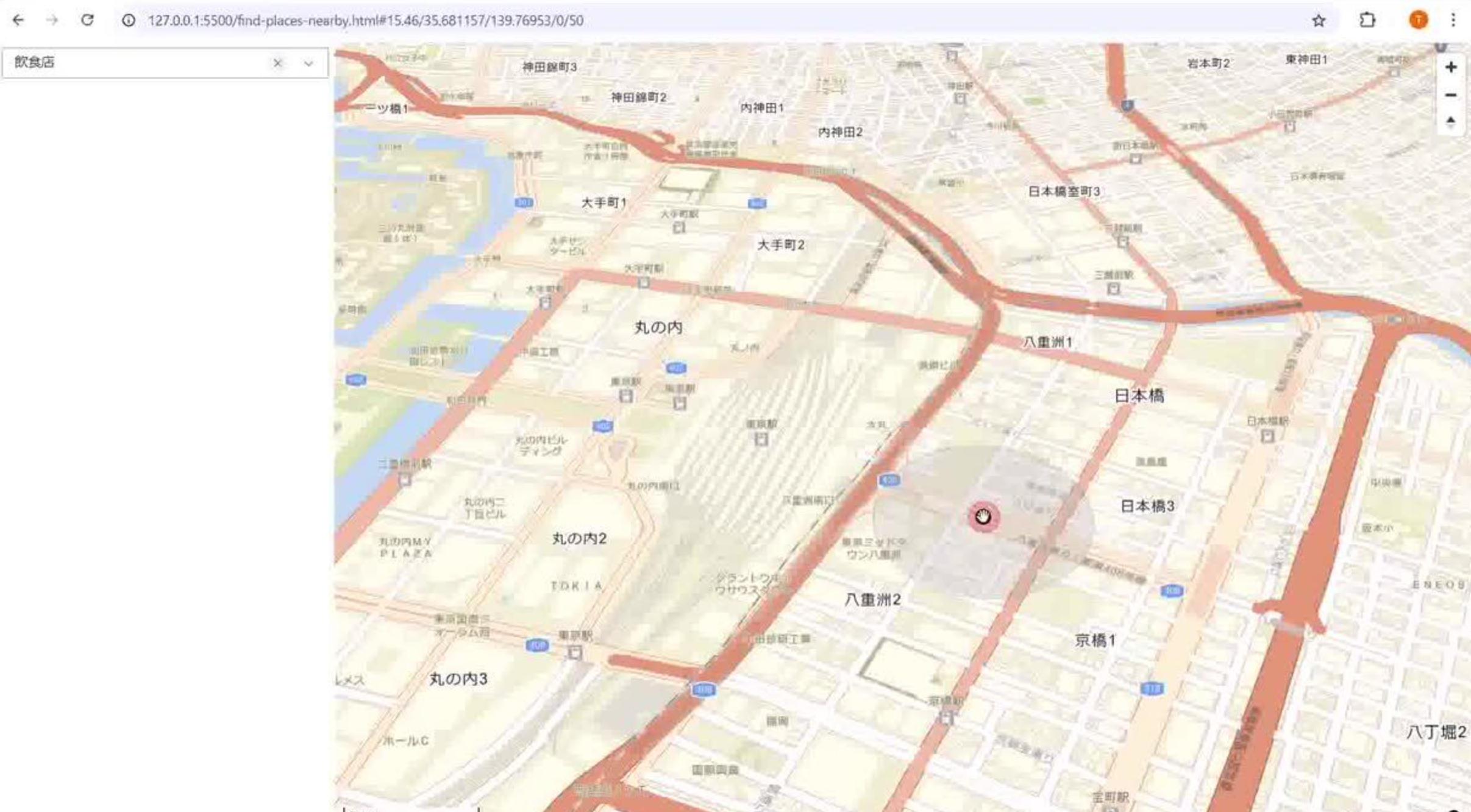
MapLibre Services
MapLibre Services (MapLibre GL + self-hosted service ecosystem) is a geospatial service platform built around MapLibre GL, an open-source map rendering library. Originally derived from the open-source version of Mapbox GL JS, this project enables high-speed vector map rendering, custom style display, and the development of interactive mapping applications. MapLibre Services is characterized by its ability to operate functions such as tile delivery, style management, geocoding, and routing on self-managed servers, allowing for flexible map service construction while avoiding cloud dependency. This enables enterprises and research institutions to securely manage their own geospatial data while developing advanced web mapping applications.
2026-03-24 19:02:15
Putnins P5 Projection
Putnins P5 Projection is a mathematical method in map projections, belonging to the pseudocylindrical projection category. It is primarily used to transform the Earth's three-dimensional surface into a two-dimensional plane in a specific manner, balancing distortions in area, shape, or angle. It is suitable for thematic mapmaking and the visualization of geographic information for specific regions.
2026-03-24 18:56:47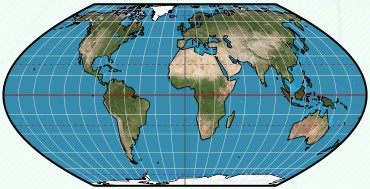
Putnins P4 Projection
Putnins P4 Projection is a pseudocylindrical projection that maintains approximate accuracy in area proportions to balance map distortion, making it suitable for mapping mid-scale regions. This projection compresses distortion in polar areas while generally achieving a compromise between shape and area representation, positioning it as a balanced solution among pseudocylindrical projections.
2026-03-24 18:53:20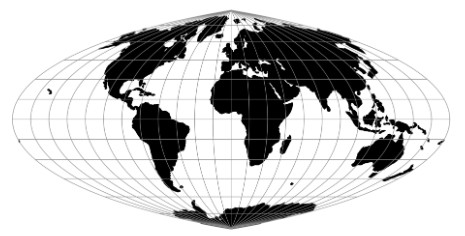
Putnins P2 Projection
Putnins P2 Projection is a pseudocylindrical equal-area map projection proposed by R. V. Putnins in 1934, primarily used for creating thematic world maps. This projection employs a specific mathematical method to transform the curved geometric features of the Earth onto a plane. It is characterized by a central meridian that is a straight line with a length half that of the equator, and parallels that are straight lines parallel to the equator, with spacing decreasing as latitude increases. There is no distortion along the central meridian or at latitudes 36°46′ N/S, but distortion gradually increases farther away from these areas.
2026-03-24 18:49:54
Kavrayskiy VI Projection
The Kavrayskiy VI Projection is a pseudocylindrical equal-area map projection. Its central meridian is a straight line with a length half that of the equator, while the other meridians are symmetrical sinusoidal curves curving toward the central meridian. The parallels are equally spaced straight lines perpendicular to the central meridian. The projection maintains true scale at latitudes 47°33′ N/S, with no distortion along these specific parallels. Although significant distortion occurs in polar regions, the overall distortion level is lower than that of most pseudocylindrical projections. Due to its equal-area property, it is suitable for statistical maps that require accurate representation of area proportions.
2026-03-24 18:43:32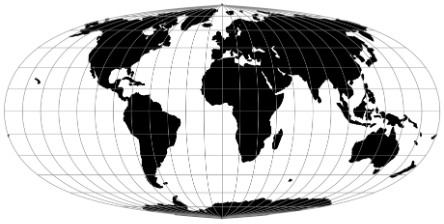
Kavrayskiy V Projection
Kavrayskiy V Projection is a map projection proposed by Soviet scholar Vladimir Kavrayskiy. It belongs to the pseudocylindrical projection family and aims to balance angular and areal distortion, with minimal distortion near the standard latitudes of 47°33′ N/S. It is suitable for global map production, though some distortion remains in polar regions.
2026-03-24 18:40:20
Tokyo UTM Zones
Tokyo UTM Zones are historic projected coordinate systems applying the UTM projection to the Tokyo datum (Bessel 1841 ellipsoid), serving as Japan's fundamental geodetic framework until 2002. While modern systems like JGD2000/JGD2011 UTM zones have superseded them, these zones remain essential for interpreting 20th-century Japanese geographic data.
2026-03-14 13:57:54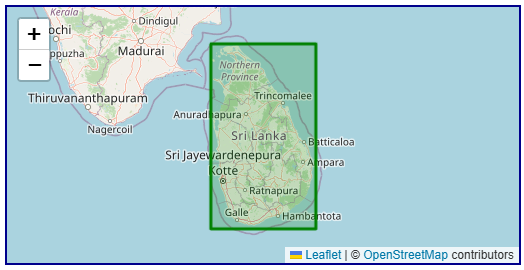
Sri Lanka Kandawala Grid
Sri Lanka Kandawala Grid is a historic projected coordinate system based on the Kandawala datum, established during the British colonial period to serve as the foundational mapping framework for the island nation. Developed in the early 20th century, this system employs a transverse Mercator projection to support cadastral surveying, topographic mapping, and engineering projects throughout Sri Lanka. While modern systems like SLD99 / Sri Lanka Grid 1999 (EPSG:5235) have been introduced for contemporary applications, the Kandawala Grid remains essential for interpreting the extensive archive of 20th-century geographic data across the country.
2026-03-13 15:53:52