Service

Planet Labs API
Jan 23,2026
GISBox is a one-stop 3D GIS data editing, conversion and publishing platform that supports editing in multiple GIS formats such as OSGB/GEOTIFF/RVT, converting to 3DTiles/Terrain and publishing.
Introduction
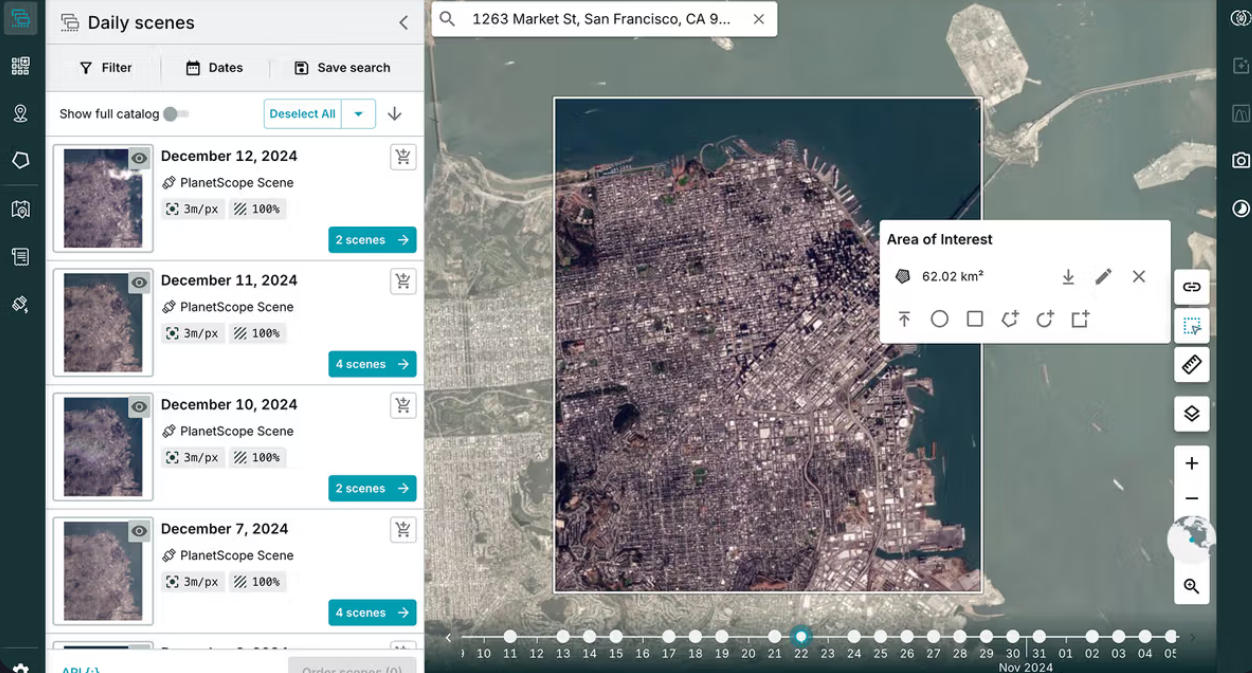
Planet Labs API is an API provided by the US-based company Planet Labs for delivering Earth observation satellite data. It is characterized by its ability to programmatically search, retrieve, and analyze satellite imagery captured by a large number of small Earth observation satellites (known as the "Dove" constellation), offering high-frequency and high-temporal-resolution data. A key strength lies in its "daily revisit" capability, enabling near-real-time monitoring of surface changes—a significant departure from traditional satellite data services.
File Structure
The Planet Labs API consists of multiple functional components designed for end-to-end management of Earth observation data, from search to retrieval and administration:
- Data Catalog API: Allows fast search of available satellite imagery based on criteria such as acquisition date, cloud cover, sensor type, and geographic area of interest (AOI).
- Data Products: Offers multiple satellite datasets tailored to different use cases, such as PlanetScope (3–5m resolution for high-frequency observation) and SkySat (sub-meter resolution for high-detail analysis).
- Ordering and Delivery API: Enables users to order imagery in specified formats (e.g., GeoTIFF) and retrieve it via cloud delivery.
- Analytics and Correction Features: Provides pre-processed data with radiometric correction, orthorectification, cloud masking, and more, streamlining analysis workflows.
- Authentication and Access Management: Uses API key-based authentication to control data access according to contractual agreements.
Pros
- High-Frequency Observation for Time-Series Analysis: Near-daily global coverage allows continuous monitoring of land-use changes, post-disaster situations, crop growth, and more.
- High Automation Capability via API: Enables direct programmatic data search and retrieval, facilitating easy integration into GIS, remote sensing analysis, AI training pipelines, and other workflows.
- Diverse Resolution and Product Lines: Supports a range of satellite data, from medium-resolution wide-area monitoring to high-resolution detailed analysis, tailored to specific needs.
- Cloud-Friendly Design: Highly compatible with cloud storage and analytics platforms, making it suitable for large-scale data processing and continuous monitoring.
Cons
- Cost Implications of a Commercial Service: High-frequency, high-resolution data may lead to elevated costs depending on usage scale and duration.
- Impact of Cloud Cover: As an optical satellite service, it is susceptible to cloud interference, which can hinder stable acquisition of clear imagery in certain regions or seasons.
- Requires Expertise: Utilizing the API and performing satellite image analysis demand specialized knowledge in remote sensing, GIS, and programming.
- Usage Restrictions: Depending on the contract, limitations may apply to data accessibility and redistribution terms, requiring careful attention.
Application Scenario
The Planet Labs API is particularly effective in fields that require frequent monitoring of surface changes. In agriculture, it supports crop health assessment, yield prediction, and anomaly detection. In insurance and finance, it aids post-disaster damage assessment and risk analysis. For urban development and infrastructure management, it enables tracking of construction progress and unauthorized development. In environmental monitoring, it is used for deforestation and water body change detection. Furthermore, research institutions and startups widely adopt it as a global-scale time-series analysis platform, often combined with AI and machine learning.
Example
1. Real-Time Image of Earth.