Service

Lisbon 1890 (EPSG:4803)
Dec 29,2025
GISBox is a one-stop 3D GIS data editing, conversion and publishing platform that supports editing in multiple GIS formats such as OSGB/GEOTIFF/RVT, converting to 3DTiles/Terrain and publishing.
Introduction
Lisbon 1890 (EPSG:4803) is a regional non-geocentric datum established by Portugal at the end of the 19th century. It primarily provided a unified coordinate framework for the country's early terrestrial surveying and topographic mapping (for example, when combined with the Bonne projection to form EPSG:2963). As a national standard from a specific historical period, it has been completely superseded by modern geocentric datums (e.g., ETRS89). Its current value is limited solely to processing and converting legacy Portuguese data such as historical maps and cadastral archives from the late 19th to mid-20th century, which, after professional conversion, can be used for digital archiving and historical geographic analysis.
Coordinate System Composition
The coordinate structure of Lisbon 1890 (EPSG:4803) is a two-dimensional geographic coordinate system (longitude, latitude) based on the Lisbon meridian as the prime meridian and the Bessel 1841 ellipsoid. Its core feature is regional geocentric positioning, which results in fundamental differences between its origin and prime meridian and the modern global geocentric coordinate system.
Pros
- Achieved National Surveying Unification: In 1890, it established Portugal's first modern, nationally unified geodetic datum, ending the potential confusion of disparate surveying standards across different regions. It laid the foundation for systematic national map production and land management.
- High Regional Fitting Accuracy: As a "non-geocentric datum," its ellipsoid was specifically positioned to best fit Portugal's territory, achieving the highest possible accuracy within the country under the technological conditions of the time, fully meeting surveying needs for that era and subsequent decades.
- Defined a National Coordinate Origin: Adopting the Lisbon meridian as the prime meridian held significant national identity and sovereign symbolism, facilitating national construction and administration centered on the capital at the time.
Cons
- Technologically Completely Obsolete: Its non-geocentric nature results in fundamental, systematic deviations on the order of hundreds of meters compared to modern geocentric coordinate systems like WGS84, making it directly incompatible with any satellite positioning data (e.g., GPS).
- Extremely Narrow Coverage: Designed solely for Portugal, it is strictly limited to Portuguese mainland territory and is meaningless outside this scope.
- Officially and Completely Superseded: Portugal and Europe have now fully adopted modern, satellite-based coordinate systems. This datum has long been obsolete in both legal and practical contexts.
- Complex and Specialized Data Conversion: Converting to coordinate systems like WGS84 requires simultaneous handling of both datum transformation (origin, ellipsoid) and prime meridian shift (Lisbon → Greenwich). The process is complex and prone to error, requiring the use of specialized parameters.
Application Scenario
The application scenario of Lisbon 1890 (EPSG:4803) is entirely limited to historical data processing. Its sole practical use is to serve as a "spatio-temporal bridge" for accurately interpreting, digitizing, and converting the original coordinates found in official topographic maps, cadastral archives, and engineering drawings produced from the late 19th to mid-20th century that were based on the Lisbon meridian in Portugal. This allows the data to be transformed and integrated into modern GIS systems for purposes such as precise historical geography research, cultural heritage site identification, legal boundary verification, or the digital reconstruction of specific historical projects.
Example
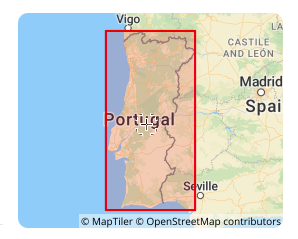
1. The covered area of the coordinate reference system according to the EPSG database.