
 Service

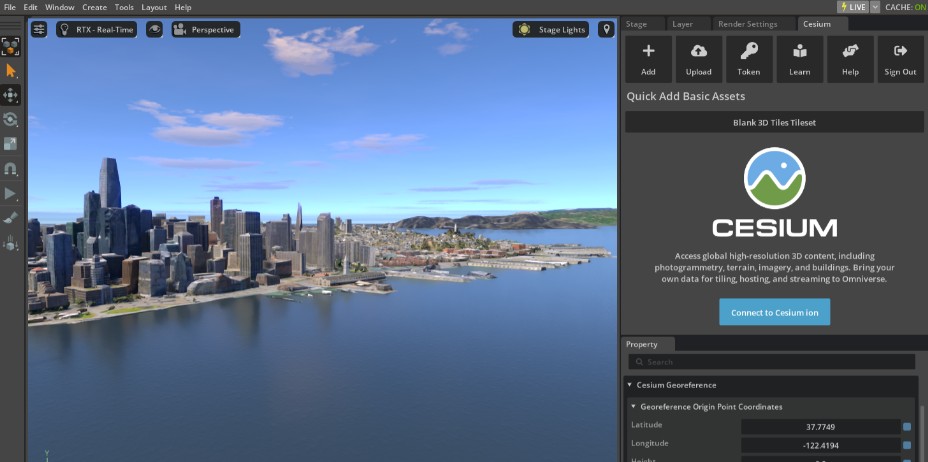
Cesium Ion API
Cesium Ion API is a cloud interface service provided by the Cesium platform for accessing its hosted global geospatial data, such as high-precision terrain, imagery, and 3D models. It uses an Access Token for authentication, allowing developers to call this API within their applications to quickly load high-quality 3D geographic data and achieve immersive globe visualization. It also supports users in uploading and managing their own spatial data assets, which can then be published and shared via the API.
2026-04-24 16:29:27
Gaode LBS Cloud
Gaode LBS Cloud is a spatiotemporal intelligence platform for the industrial sector under the Gaode Map brand. Leveraging the "Yunrui" spatiotemporal industry large model and the "Yunjing" 3D reconstruction platform, it provides intelligent solutions based on spatiotemporal data for industries such as offline retail, transportation, logistics, energy, and finance. Integrating AI with spatial intelligence technologies, it supports dynamic 3D urban reconstruction and intelligent decision-making, helping enterprises achieve full-chain digital upgrades in site selection, operations, and dispatching. Starting in 2024, the platform has fully opened its development capabilities and has established its first Spatiotemporal Smart City Operations Center in Quzhou.
2026-04-24 16:22:55
Tencent Maps API
Tencent Maps API (Tencent Map Location Service Platform) is a location service interface provided by Tencent. Developers can call its capabilities for mapping, positioning, route planning, place search, etc., via multiple technical platforms such as JavaScript, Android, and iOS, enabling rapid integration of map functionality into applications or websites. The API supports free Key application with no call frequency limits and is widely used in industries such as mobility, logistics, and retail, offering high-precision positioning, real-time traffic conditions, reverse geocoding, and a wealth of other features. The platform also provides visualization tools and data services to support enterprise digital transformation.
2026-04-24 16:12:43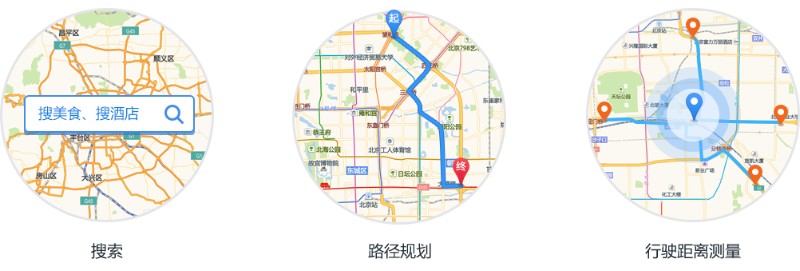
Alibaba Cloud AMap (AutoNavi) Open Platform API
Alibaba Cloud AMap (AutoNavi) Open Platform API is a standardized set of location service interfaces provided by Alibaba Group. It integrates core capabilities such as map display, geocoding, route planning, real-time traffic conditions, place search, positioning, and weather queries. The API supports integration across multiple platforms including Web, Android, iOS, and HarmonyOS, allowing developers to embed high-precision geographic information and intelligent navigation capabilities into various applications. Underpinned by Alibaba Cloud infrastructure, it ensures stable performance under high global concurrency and is widely used in digital scenarios such as mobility, logistics, smart hardware, and e-commerce.
2026-04-20 15:47:40
Azure Maps API
Azure Maps API is a set of geospatial services provided by the Microsoft Azure cloud platform. Through REST APIs and a Web SDK, it offers developers capabilities such as map rendering, geocoding, location search, route planning, real-time traffic conditions, time zone information, geolocation services, and weather data integration. It helps build intelligent location solutions for web and mobile applications and is widely used in logistics, asset tracking, IoT monitoring, and mobility services.
2026-04-20 15:39:38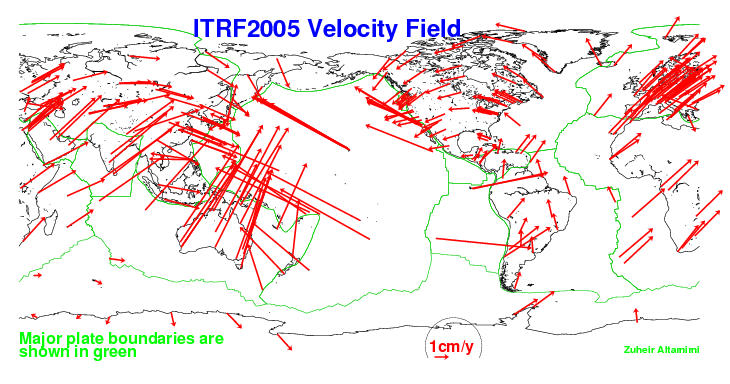
ITRF2005 (International Terrestrial Reference Frame 2005)
ITRF2005 (International Terrestrial Reference Frame 2005) is one of the international terrestrial reference systems, established by the International Earth Rotation and Reference Systems Service (IERS). ITRF2005 is a three-dimensional terrestrial coordinate system generated by integrating data from multiple space geodetic techniques, including GPS, VLBI, SLR, and DORIS. It defines the positions of observation points on the Earth's surface and their temporal changes with high precision. ITRF2005 adopts an Earth-Centered, Earth-Fixed (ECEF) coordinate system and is a dynamic reference frame that accounts for temporal changes such as crustal deformation and plate motion. It is widely used in GIS, satellite positioning, Earth science research, and other fields, and is registered under EPSG code EPSG:4896.
2026-04-20 15:33:33
ITRF2008 (International Terrestrial Reference Frame 2008)
ITRF2008 (International Terrestrial Reference Frame 2008) is an international three-dimensional terrestrial reference system constructed based on global geodetic observation data. Published by the International Earth Rotation and Reference Systems Service (IERS), which oversees global geodesy and Earth rotation observations, it is one of the international reference frames created by integrating multiple space geodetic techniques such as GNSS, VLBI, SLR, and DORIS. ITRF2008 is defined as a three-dimensional Cartesian coordinate system (X, Y, Z) with its origin at the Earth’s center, enabling high-precision positioning that accounts for plate motion and crustal deformation. It is widely used as a reference frame in many satellite positioning systems and international geodetic networks, forming the foundation for Earth science research and high-precision positioning. In EPSG, it is defined as EPSG:5332.
2026-04-20 15:28:58
WGS84 / Pseudo-Mercator (EPSG:3857)
WGS84 / Pseudo-Mercator (EPSG:3857) is a projected coordinate system widely used in modern web mapping services. It is based on the WGS 84 geographic coordinate system and employs a simplified version of the traditional Mercator projection adapted for web display. Primarily designed for rendering tile-based web maps, it serves as the standard display coordinate system for online map services and GIS platforms. By converting geographic coordinates expressed in degrees to plane coordinates in meters, it facilitates fast map rendering and zooming operations.
2026-04-14 19:31:45
WGS84 (G1674) (World Geodetic System 1984)
WGS84 (G1674) is one of the updated realizations of the globally used World Geodetic System 1984 (WGS84), a frame that has been improved in accuracy based on GNSS observation data. The EPSG code EPSG:4979 defines a three-dimensional geographic coordinate system that represents a position using three components: latitude, longitude, and ellipsoidal height. WGS84 (G1674) is primarily used in global navigation satellite systems and is widely employed as the positioning reference, especially for GPS. Based on an Earth-Centered, Earth-Fixed (ECEF) framework and using an Earth ellipsoid model, it enables highly accurate representation of positions on the Earth's surface.
2026-04-14 19:26:19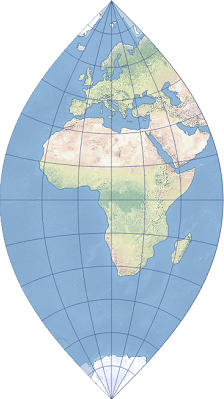
Pulkovo 1942 / Gauss–Krüger projection
Pulkovo 1942 / Gauss–Krüger projection is a combination of a geodetic datum and a projection method widely used in the former Soviet Union and Eastern Europe. Pulkovo 1942 is a national geodetic datum established by the Soviet Union, adopting the Krasovsky ellipsoid as its reference ellipsoid. The Gauss–Krüger projection is a transverse Mercator projection that converts the Earth's surface into plane coordinates using longitudinal zones. This combination was used for decades in topographic mapping, military surveying, cadastral surveying, and other applications across the former Soviet republics.
2026-04-14 19:21:53