
 Service

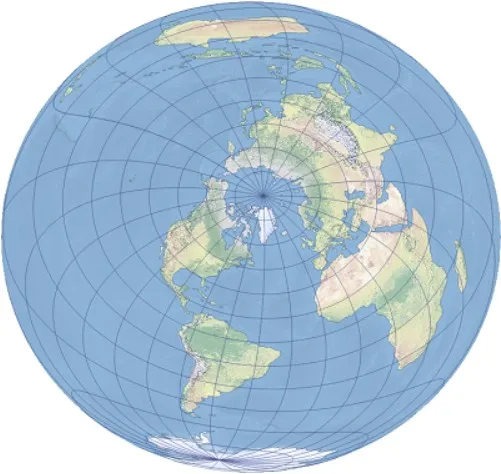
Two-point Equidistant Projection
The latitude and longitude network of a 2-point Equidistance Projection typically exhibits complex curves that do not maintain symmetry, with deformations in shape, area, and direction, but can preserve the true distance between two selected points and other points. The National Geographic Society of the United States once applied it to map Asia, while Bell Telephone System Company used an improved version to calculate long-distance telephone rates. The projection parameters include the east offset, north offset, and latitude and longitude coordinates of two points, and only support spherical models. Elliptical models cannot fully maintain equidistant properties. When two projection points coincide, the projection is transformed into an equidistant azimuthal projection.
2025-11-05 16:01:53_1762329695056.png)
Times Projection
Times projection is a compromise pseudocylindrical map projection developed by John Moir in 1965 for the British cartographic company Bartholomew Ltd. It is based on a modified Gall stereographic projection, but with meridians as curved lines rather than straight lines.
2025-11-05 15:59:59_1762329551232.png)
Peirce Quincuncial Projection
Peirce Quincuncial projection is a conformal map projection that presents the globe as a square frame, with the equator displayed as a rotated square centered on the North Pole. Its core characteristic is accurate local shape and orientation (conformal properties), but angular distortion occurs at the center of the four sides. The projection supports seamless tessellation, or mosaicking, allowing the construction of a continuous world route network by stitching together multiple tiles. This projection is particularly useful in aviation and maritime applications, where a coherent view of global navigation routes is required.
2025-11-05 15:58:30_1762329480207.png)
Patterson Projection
Patterson projection is a compromise cylindrical map projection designed by Tom Patterson. Its structure of equally spaced meridians and symmetrical parallels achieves low distortion in the equatorial region while optimizing the shape of high-latitude regions (superior to the Miller projection). Although it is a non-equal-area projection and only supports spherical models, its visual balance and compatibility with mainstream GIS platforms such as ArcGIS make it widely used in scenarios that do not require precise area calculations, such as education and popular science, time zone display, and thematic mapping of areas around the equator.
2025-11-05 15:57:26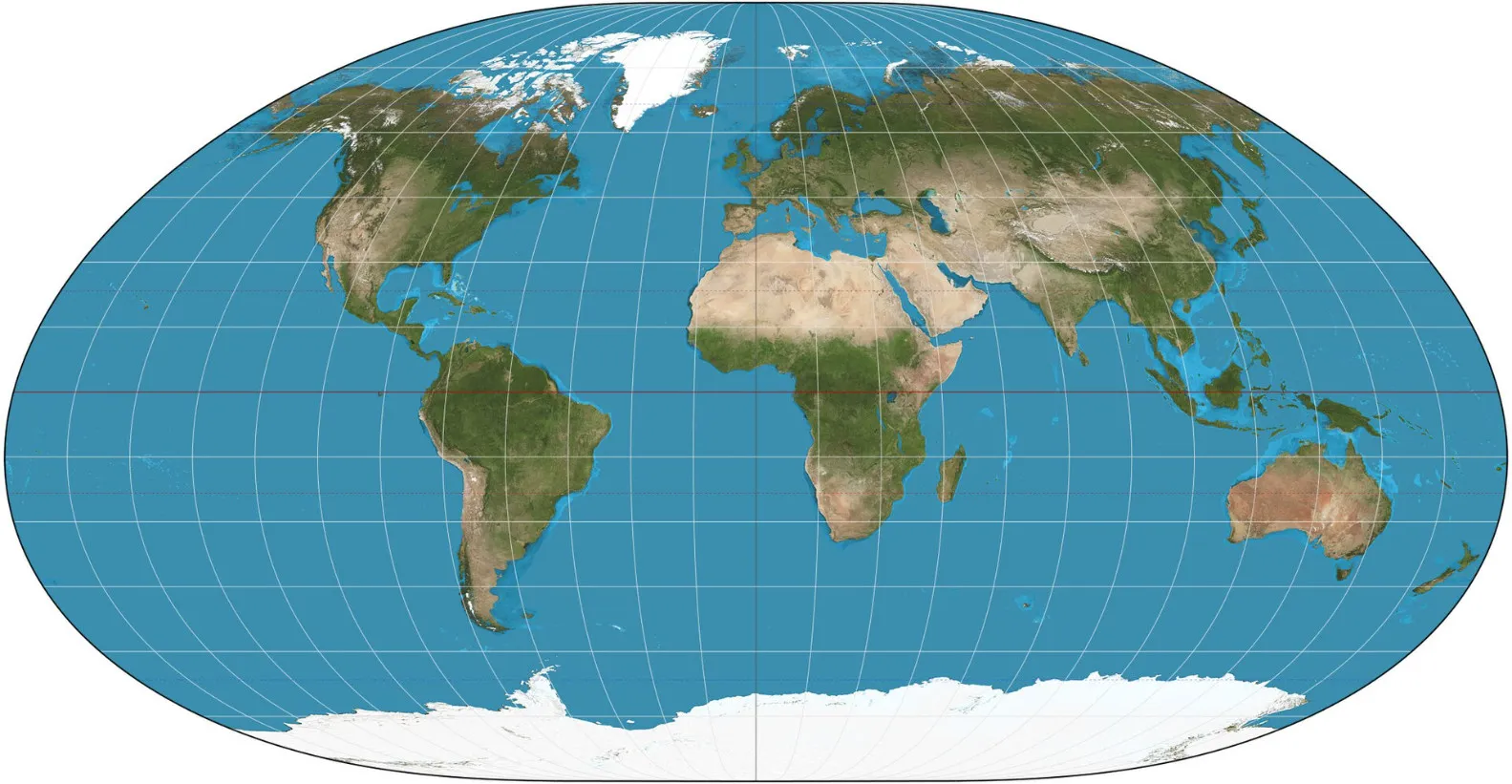
Loximuthal Projection
Loximuthal projection is a pseudocylindrical map projection proposed by Carl Simon in 1935. Its core characteristic is that rhumb lines (loxagonal courses) from a central point (the intersection of the central meridian and the central parallel) are displayed as straight lines, while maintaining true bearing and scale. The projection is neither equal-area nor conformal, but was originally designed to provide accurate compass bearings for maritime navigation while clearly defining local shapes by accurately representing course and distance from a central point.
2025-11-05 15:56:34_1762329353567.png)
Hotine Projection
Hotine projection, also known as a specific implementation of the Oblique Mercator projection, is a conformal map projection developed and popularized by British geodesist Martin Hotine in the mid-20th century for his geodetic work in British colonies, primarily in the Malay Peninsula.
2025-11-05 15:55:24_1762329312411.jpg)
Hammer Aitoff Projection
Hammer projection is a modification of the Lambert azimuthal equal-area projection, also known as the Hammer–Aitoff projection. It was developed in 1892 by German cartographer Ernst von Hammer, who was inspired by the work of Russian cartographer David A. Aitoff and, as such, represents an improvement on the Aitoff projection.
2025-11-05 15:54:36_1762329088768.png)
Gall Stereographic Projection
Gall stereographic projection is a cylindrical projection that projects the Earth's surface from a point opposite the equator onto a cylindrical surface, with the standard parallel fixed at 45 degrees. Its characteristics are parallel straight lines and equal-length curves of longitude. The scale is accurate along the standard parallels and remains constant between parallels equidistant from the equator. While it is neither equal-area nor equidistant nor conformal, it balances the scale of mid-latitudes, avoiding excessive stretching at the poles or compression at the equator, while maintaining high shape fidelity.
2025-11-05 15:51:00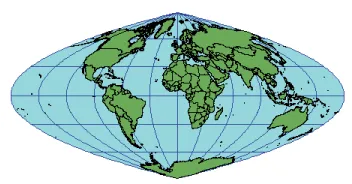
Craster Parabolic Projection
Craster parabolic projection is a type of map projection classified as a pseudo-cylindrical projection that projects the Earth's surface onto a flat surface in a manner that approximates the shape of a parabola. This method was invented by John Craster in 1910 and is primarily used to create world maps. The map's parallels are straight and evenly spaced, while the meridians, except for the central meridian, are parabolic. It achieves a relatively smooth visual balance while minimizing area distortion, making it suitable for educational materials and visually easy-to-understand globe displays.
2025-11-05 15:47:48_1762328853812.png)
Berghaus Star AAG
Berghaus Star Projection is a unique map projection that divides the entire surface of a globe into a star shape. It was invented in the 19th century by German geographer Hermann Berghaus and has been used primarily for decorative or educational purposes due to its beauty and unique composition. The variation used by the American Association of Geographers (AAG) in particular is known as an iconic design in geography.
2025-11-05 15:47:03